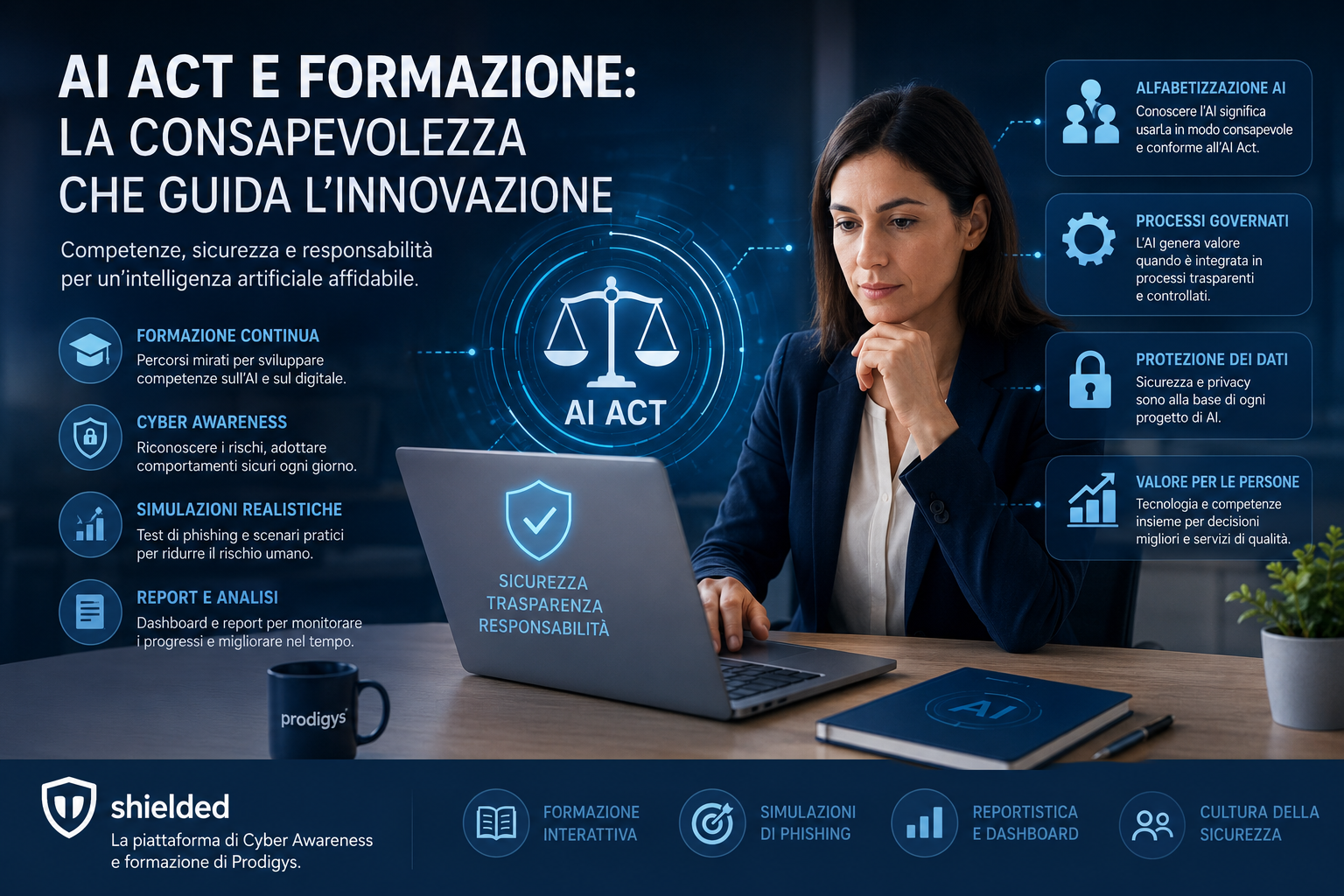
Artificial intelligence is now part of everyday processes in businesses, public authorities and organisations. It is used to analyse data, support decisions, automate repetitive tasks, improve communications and make services more efficient. But adopting AI cannot be treated as a technology choice alone. With the AI Act coming into force, it is increasingly clear that innovation also means training people, defining responsibilities and building a conscious digital culture.
The key is not only to introduce new tools, but to make sure that users understand their opportunities, limits and risks. AI can create value when it is part of processes that are governed, transparent and secure. Without adequate training, it can amplify errors, unchecked automation, improper data use and decisions that are difficult to review. Training is therefore essential to using artificial intelligence reliably.
The AI Act: from technology to organisational responsibility
The AI Act establishes a European framework to promote safe, transparent and human-centred artificial intelligence. One important aspect for public and private organisations is AI literacy: people using AI systems should have an appropriate level of knowledge for their context of use, the risks involved and the operational consequences.
This means compliance is not limited to documents, policies or technical assessments. It also concerns everyday behaviour: how users interpret a system-generated suggestion, verify an output, handle personal or sensitive information, involve human oversight and take precautions before making a decision.
From this perspective, the AI Act encourages organisations to adopt a more mature approach. Buying or integrating a technology is not enough; organisations must create the conditions for its proper use. Responsible innovation also depends on preparing people.
AI training: practical skills, not theory alone
AI training should be practical. It is not enough to explain what an algorithm is or present generic scenarios. Users need to understand how AI fits into their processes, what data it uses, what outputs it produces and which checks need to remain in place.
For a public authority, this could mean training staff to use AI tools responsibly in document management, resident support, case analysis or information classification. For a business, it could mean teaching employees to recognise AI-generated content, avoid sharing business data inappropriately and assess automated suggestions critically.
Training should bring together three areas: digital skills, awareness of applicable requirements and cybersecurity. This is how AI becomes useful and governable, rather than opaque or left to individual discretion.
The link between the AI Act and cybersecurity awareness
AI adoption also increases exposure to new cyber risks. More convincing phishing, AI-enabled social engineering, personalised fraudulent messages and synthetic content make it harder to distinguish legitimate communications from threats. For this reason, training in this new regulatory environment cannot be separated from cybersecurity awareness.
An organisation using AI needs to prepare people to recognise increasingly sophisticated digital risks. Security depends not only on firewalls, antivirus software and technical procedures, but also on people’s ability to spot unusual signs, verify sources, protect credentials and data, report incidents and follow internal policies.
A security-aware culture is an integral part of AI governance. Every innovation project should include training, simulations, measurement and regular updates.
Shielded: training, simulations and measurable awareness
To address this need, Prodigys offers Shielded, a platform for developing a culture of digital security through modular training, cyber awareness programmes and realistic phishing simulations.
Shielded helps organisations guide employees, operators and internal leads through ongoing learning. Training content covers threats, safe behaviour, social engineering, information handling and good operational practices. Phishing simulations let people apply what they have learned in realistic scenarios, highlighting areas of risk and specific training needs.
The platform also provides management value. Reports and dashboards help monitor progress, exposure levels, campaign outcomes and improvement trends. IT, HR, compliance and operations teams can make training measurable, documented and useful for audit purposes.
From mandatory training to organisational culture
A common mistake is to treat training as a one-off requirement: a course to complete, a signature to collect or a box to tick. The AI Act and the evolution of digital threats call for a different approach. Awareness needs to be maintained over time, updated as risks change and integrated into everyday behaviour.
Shielded supports this shift with continuous, adaptable programmes. Training can be organised by role, risk level, organisational needs and simulation outcomes. Users receive content that better matches their operational context, and organisations can target areas where weaknesses emerge.
Real compliance begins when people understand the purpose of the rules and know how to apply them in their daily work. This applies to cybersecurity and data protection, and increasingly to artificial intelligence as well.
Innovate safely, responsibly and in compliance
The AI Act is an important milestone because it shifts attention from technological enthusiasm to the quality of adoption. Organisations that want to use artificial intelligence need to prepare culturally, operationally and through training, as well as technically.
Investing in training helps reduce human risk, improve security, build trust in digital tools and demonstrate a responsible approach to innovation. It also creates an environment where AI is used more consciously, under human oversight and with attention to its impact on data, processes and people.
With Shielded, Prodigys offers a practical way to support this journey through interactive training, realistic simulations, reporting and ongoing digital awareness. AI can create value only when organisations are ready to govern it. Knowledge is the first step.